

Baby Teeth Chart: When Every Tooth Comes In and Falls Out
Children get twenty baby teeth, starting around six months and finishing near age three, then lose them in roughly the same order between ages six and twelve while thirty-two permanent teeth take their place. Baby teeth, milk teeth, and primary teeth all name the same twenty teeth, so a milk teeth chart and a baby teeth chart show the same thing. The charts below give the age range for every tooth coming in and falling out, plus how many teeth to expect at each age. Read them as a guide rather than a schedule: a few months either side of these ranges is normal, and the order matters more than the exact age. Here is the full timeline, what to expect at each stage, and the specific timing differences worth having checked.
Quick answer: Baby teeth usually start coming in around 6 months, beginning with the two lower front teeth, and all 20 are typically in by age 3. They start falling out around age 6, generally in the order they arrived, and the last ones go around age 12. Permanent teeth replace them as they go, with the first permanent molars arriving around age 6 behind the baby teeth without replacing anything.
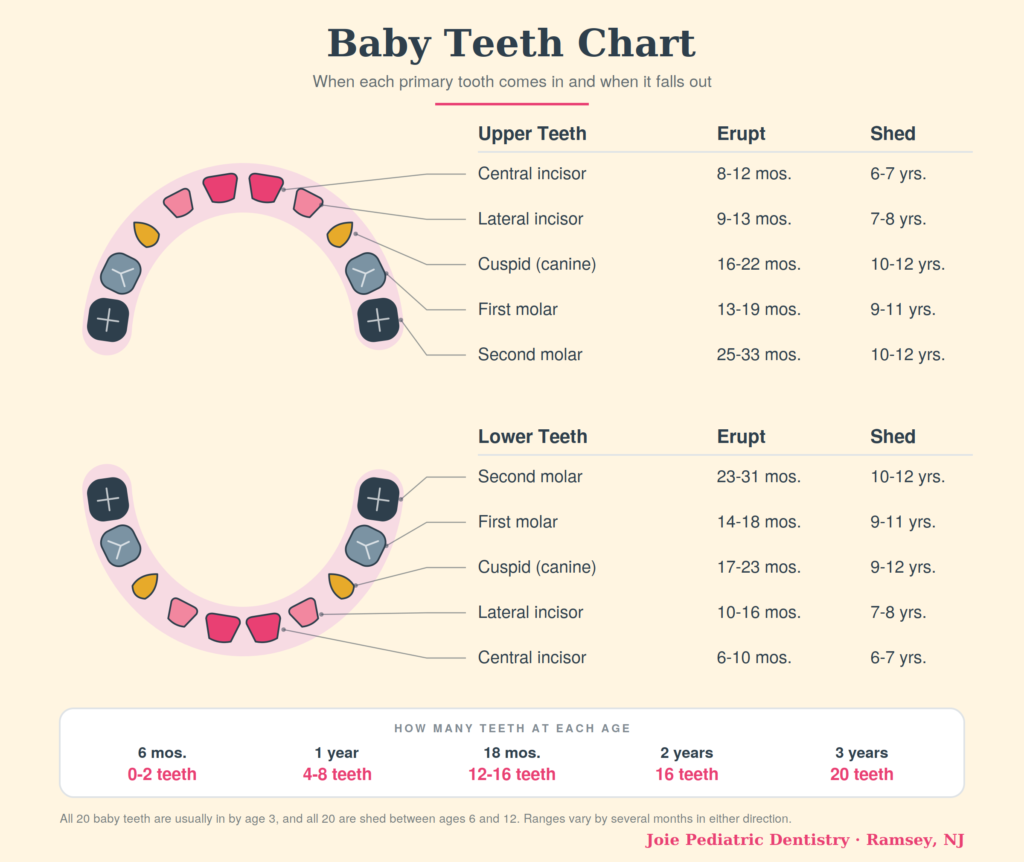
Baby Teeth Chart: When Each Tooth Comes In
Teeth erupt in pairs, one on each side, and the lower teeth usually arrive slightly before their upper counterparts. The first molars break the front-to-back pattern by coming in before the canines. The eruption ranges published for primary teeth are wide on purpose, because healthy children vary by several months in either direction.
| Tooth | Upper teeth | Lower teeth |
| Central incisors (front) | 8 to 12 months | 6 to 10 months |
| Lateral incisors | 9 to 13 months | 10 to 16 months |
| First molars | 13 to 19 months | 14 to 18 months |
| Canines (cuspids) | 16 to 22 months | 17 to 23 months |
| Second molars | 25 to 33 months | 23 to 31 months |
Upper and lower differ enough to be worth splitting out. The lower central incisors typically arrive about two months ahead of the upper ones, while the upper lateral incisors come in ahead of the lower, which is why a baby often has four teeth on the bottom and two on top, or the reverse, for a few weeks at a time.
Milk Teeth and Baby Teeth Are the Same Twenty Teeth
Milk teeth, baby teeth, primary teeth, and deciduous teeth all describe the first set of twenty. Which term you hear depends on region and on who is speaking: milk teeth is common in British and Indian English and among plenty of parents in the United States, while primary or deciduous is what appears in a dental record. A milk teeth schedule and a baby teeth schedule are the same document, and the milk teeth order is the eruption order in the chart above: two lower front teeth, then the upper front four, then the lateral incisors, then first molars, canines, and second molars last. All twenty milk teeth are shed. None of them stay, which is where deciduous comes from, borrowed from the word for trees that drop their leaves.
The Order Baby Teeth Come In
The sequence is more reliable than the calendar. The two bottom front teeth arrive first, followed by the four top front teeth, then the lateral incisors filling in beside them. Next come the first molars, which surprises parents who expect the canines to arrive in order, and the canines slot into the gap afterward. The second molars finish the set somewhere between two and three years old. That is the standard order of teeth in infants, and it holds far more consistently than the ages do.
If a tooth arrives out of sequence, that is usually still normal. What draws attention is a large asymmetry, like a tooth on one side erupting many months before its twin on the other, which is worth having looked at. A small number of babies are born with a tooth already through, and some do not get their first until well after their first birthday, and both usually turn out fine. Sore gums, drooling, and broken sleep often show up a few days before the tooth itself, and the symptoms that are expected and the ones that are not are worth knowing apart, since a high fever is not part of teething.
How Many Teeth Kids Have at Each Age
Counting teeth is a simple way to check whether things are roughly on track. By the first birthday most children have between four and eight teeth, usually the front ones. By eighteen months the first molars and lateral incisors have generally arrived, bringing the count to twelve to sixteen. By age two most children have around sixteen, and by age three the full set of twenty is usually in: ten on top, ten on the bottom, made up of eight incisors, four canines, and eight molars.
| Age | Teeth usually present |
| 6 months | 0 to 2 |
| 9 months | 2 to 4 |
| 12 months (1 year) | 4 to 8 |
| 15 months | 8 to 12 |
| 18 months | 12 to 16 |
| 2 years | 16 |
| 2 and a half years | 16 to 20 |
| 3 years | 20, the complete set |
That complete set stays in place for about three years. Around age four you may notice gaps opening between the front teeth, which alarms some parents but is a good sign: the jaw is growing to make room for the permanent teeth, which are considerably wider than the baby teeth they replace. Crowded, gap-free baby teeth are more likely to predict crowding later than spaced ones
When Baby Teeth Fall Out: The Shedding Chart
All twenty baby teeth fall out. They generally leave in the order they arrived, starting around age six with the lower front teeth and finishing around age twelve with the second molars. The process spans six years with quiet stretches in between: most children lose eight teeth between six and eight, then very little happens until around nine, when the molars and canines start to go.
| Tooth | Age it falls out |
| Central incisors (front) | 6 to 7 years |
| Lateral incisors | 7 to 8 years |
| First molars | 9 to 11 years |
| Canines (cuspids) | 9 to 12 years |
| Second molars | 10 to 12 years |
A tooth becomes loose because the permanent tooth underneath is dissolving its root, so a tooth that is ready comes out with little blood and no real pain. Forcing one that is not ready causes both. The readiness test and the safe technique are covered in how to tell whether a loose tooth is ready to come out
Permanent Teeth: What Replaces Them and When
Thirty-two permanent teeth eventually replace the twenty baby teeth, which means twelve of them have no baby predecessor at all and simply appear at the back of the jaw as it grows.
| Permanent tooth | Age it comes in |
| First molars | 6 to 7 years |
| Central incisors | 6 to 8 years |
| Lateral incisors | 7 to 9 years |
| First premolars | 9 to 11 years |
| Canines (cuspids) | 9 to 12 years |
| Second premolars | 10 to 12 years |
| Second molars | 11 to 13 years |
| Third molars (wisdom teeth) | 17 to 21 years |
The first permanent molars arrive around age six, behind the last baby molar, with nothing falling out to announce them, and many parents never realize these are permanent teeth. They are the ones most likely to develop a cavity early, so knowing when the six year molars and twelve year molars arrive is useful. The central and lateral incisors follow as the front baby teeth are shed. Premolars, which replace the baby molars, come in between nine and twelve, and the canines around the same window. The second permanent molars arrive at the back at eleven to thirteen, again with no tooth shed. Wisdom teeth, if they come at all, appear between seventeen and twenty-one. The years between six and twelve, when both sets are present at once, are called mixed dentition, and the uneven, gappy smile of that period is entirely normal.
When Tooth Timing Is Worth Checking
Variation is the rule, so most timing differences need nothing. A handful are worth an exam. No teeth at all by around eighteen months is worth a look, as is a full year of delay compared with the ranges above. A baby tooth lost before about age four, usually from decay or injury, matters because the neighboring teeth can drift into the space meant for the permanent tooth. A baby tooth that hangs on past age thirteen, or a permanent tooth that erupts behind a baby tooth that has not loosened, is worth checking, since the adult tooth may need a clear path. Large asymmetry between the two sides, teeth erupting badly out of sequence, or a permanent tooth that has not appeared six months after its baby predecessor came out are all reasons to have the developing teeth reviewed, sometimes with an X-ray to confirm they are present and correctly positioned.
How We Track Your Child’s Tooth Development
At every checkup we chart which teeth are in, which are on the way, and whether the sequence and spacing are developing the way they should, and from around age six we are also watching how the permanent teeth are lining up and whether the jaw has room for them. That is routine, and it is how the timing problems above get caught early, when the fix is small. It also means the answer to the question most parents actually have, whether their child is on track, comes from their own child’s chart rather than from an average. Regular kids dental cleanings and exams are where that tracking happens. If your child has not started dental visits yet, the recommendation is to begin by the first birthday or within six months of that first tooth, and our first visit page explains how we run that appointment. To book, or to ask about a tooth that seems early or late, call us at (201) 500-6314.
Let’s Make Your First Visit Easy
Whether you’re from Ramsey, Mahwah, Allendale, or anywhere in Bergen County, we’d love to welcome your family to ours.
SHOWTIMES (HOURS)
Monday: 9:00 AM – 5:00 PM
Tuesday: 9:00 AM – 5:00 PM
Wednesday: 9:00 AM – 5:00 PM
Thursday: 9:00 AM – 5:00 PM
Friday: 9:00 AM – 5:00 PM
Sat/Sun: Closed