
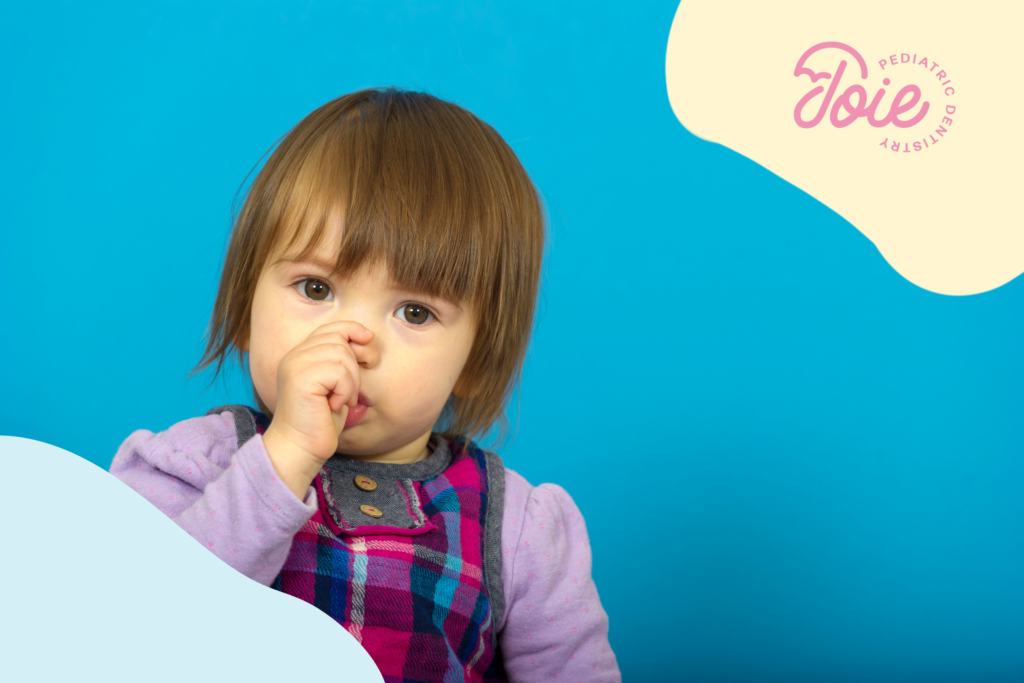
What Thumb Sucking Does to a Child’s Teeth, and When It Undoes Itself
Thumb sucking changes teeth through sustained pressure, not through the thumb itself, which is why how long and how hard matters far more than whether your child does it at all. Most children who stop by about age four end up with no lasting change. Children who continue past that, particularly into the years when permanent teeth arrive, are the ones who need help later. Here is what each change looks like in the mouth, which ones correct themselves once the habit ends, and which ones do not.
Quick answer: Thumb sucking can push the upper front teeth forward, hold the front teeth apart so they do not meet, and narrow the upper jaw. An open bite and flared front teeth usually correct on their own if the habit stops by around age four, before the permanent front teeth arrive. A narrowed upper jaw is the change least likely to fix itself. Intensity matters as much as frequency: a thumb resting passively in the mouth does far less than one sucked hard.
What sucking pressure actually changes
Three things happen at once. The thumb presses up and back against the roof of the mouth, pushing the upper front teeth forward and outward. It sits between the upper and lower front teeth, physically blocking them from meeting as they erupt. And the cheeks squeeze inward during the suction itself, which over months narrows the upper jaw.
The suction is the part parents underestimate. A child who rests a thumb in their mouth passively while falling asleep applies very little force. A child who sucks vigorously, with visible cheek movement and a callus on the thumb, applies a great deal. Two children with the same habit at the same age can end up in completely different places for this reason. A 2025 scoping review of thirty-five studies on sucking habits identified duration, frequency, and intensity together as what predicts the degree of change, rather than the habit alone.
Thumb sucking also tends to be asymmetric in a way pacifier use is not, because a thumb rests against one side of the mouth. Changes are often more pronounced on the side the thumb sits against, and that asymmetry is sometimes the first thing that gets noticed.
How to tell whether it has affected your child’s bite
Have your child bite their back teeth together normally and look at the front from the side and straight on.
| What to look at | With a sustained sucking habit | A typical bite |
| Front teeth on biting down | A visible gap remains between top and bottom | They touch or slightly overlap |
| Upper front teeth angle | Tipped forward, sometimes noticeably | Close to vertical |
| Distance top teeth sit ahead of bottom | Increased, teeth appear to stick out | Slight, a few millimetres |
| Back teeth, upper against lower | Upper molars may sit inside the lower ones | Upper molars sit outside the lower |
| Roof of the mouth | Narrower and higher | Broad and evenly rounded |
| Symmetry left to right | Often uneven, worse on the thumb side | Even |
A gap between the front teeth on its own is not evidence of anything, since spacing between a young child’s front teeth is normal and usually a good sign. What points to a sucking habit is the front teeth failing to meet when the back teeth are closed.
Which changes undo themselves
Age at stopping is the single biggest factor. Sucking in infancy and early toddlerhood is normal and carries essentially no lasting risk. Through age four, changes to the baby teeth generally correct on their own once the pressure is removed, often within six to twelve months, because the jaw is still growing and the permanent teeth have not arrived to lock the position in.
After that the picture changes. The permanent front teeth erupt around six or seven, and a habit still running at that point positions them as they come in rather than pushing them afterward. That is much harder to reverse. An open bite and flared front teeth are the two most likely to self-correct. A narrowed upper jaw and a posterior crossbite are the least likely, and are the changes most often still needing treatment years later.
The same pattern holds for pacifier use, with one practical difference: a pacifier can be taken away, weaned in stages, or lost on purpose. A thumb is available at all times and cannot be removed, which is why thumb habits tend to persist longer and, on average, do more.
What helps, and what makes it worse
Punishment, shaming, and pulling the thumb out reliably backfire, because the habit is self-soothing and stress increases it. What works is identifying when it happens, usually tiredness, boredom, or anxiety, and addressing that instead. A comfort object at bedtime, a hand to hold in the car, something to do with the hands during screen time.
Children stop most successfully when they want to. Around age four or five most are old enough to be part of the decision, and a calendar with a sticker for each dry-thumb day works better than any deterrent. Bitter nail preparations are worth using only alongside a child’s own motivation, not instead of it, and are more useful as a reminder for the unconscious moments than as a penalty.
We check bite development at every routine cleaning and exam, so a habit that is still going at four or five is worth raising there rather than waiting. If your child has not had a first visit yet, that is the place to start. If behavioural approaches have genuinely been exhausted and the habit continues past six, a fixed appliance that blocks the thumb from reaching the palate is the usual next step, and it is a short intervention rather than orthodontic treatment.
What treatment looks like if changes persist
Stopping the habit comes first, always, because nothing corrects while the pressure continues. After that, most cases are watched rather than treated, since the bite often improves on its own through the mixed-dentition years. If the front teeth still do not meet, or the upper jaw is still narrow, by about age seven or eight, interceptive orthodontics is the usual step. A palatal expander widens a narrow upper jaw, and it works best in this window while the jaw is still growing. It is not the same thing as braces and does not usually replace them later if they are needed.
Frequently Asked Questions
At what age does thumb sucking start to damage teeth?
Changes become likely once the habit continues past about age four, and much more likely past six, when the permanent front teeth begin to arrive. Before that, most changes affect the baby teeth only and reverse once the habit ends.
Will my child’s teeth fix themselves after they stop sucking their thumb?
Often, if they stop by around age four. An open bite and forward-tipped front teeth commonly correct within six to twelve months. A narrowed upper jaw is much less likely to self-correct and is the change most often still needing treatment.
Is finger sucking different from thumb sucking?
The mechanism is the same, but where the pressure lands differs, so finger sucking sometimes produces a more localized or lopsided change. The age guidance and the outlook are the same for both.
Can thumb sucking cause speech problems?
It can contribute. An open bite leaves a gap the tongue pushes through on certain sounds, which is one reason a lisp sometimes accompanies a long-running habit. Speech typically improves once the habit ends and the bite closes, and a persistent lisp after that is worth an evaluation.
Should I use a thumb guard or bitter polish?
Only alongside a child who wants to stop, not instead of that. Used as a punishment they tend to increase the anxiety driving the habit. As a reminder during the unconscious moments, for a child already trying, they can help.
We track bite development at every routine visit, so a habit that is still going at four or five is something to raise at the next appointment rather than worry about between them. To have your child’s bite looked at, call us at (201) 500-6314 or book online.
Let’s Make Your First Visit Easy
Whether you’re from Ramsey, Mahwah, Allendale, or anywhere in Bergen County, we’d love to welcome your family to ours.
SHOWTIMES (HOURS)
Monday: 9:00 AM – 5:00 PM
Tuesday: 9:00 AM – 5:00 PM
Wednesday: 9:00 AM – 5:00 PM
Thursday: 9:00 AM – 5:00 PM
Friday: 9:00 AM – 5:00 PM
Sat/Sun: Closed