
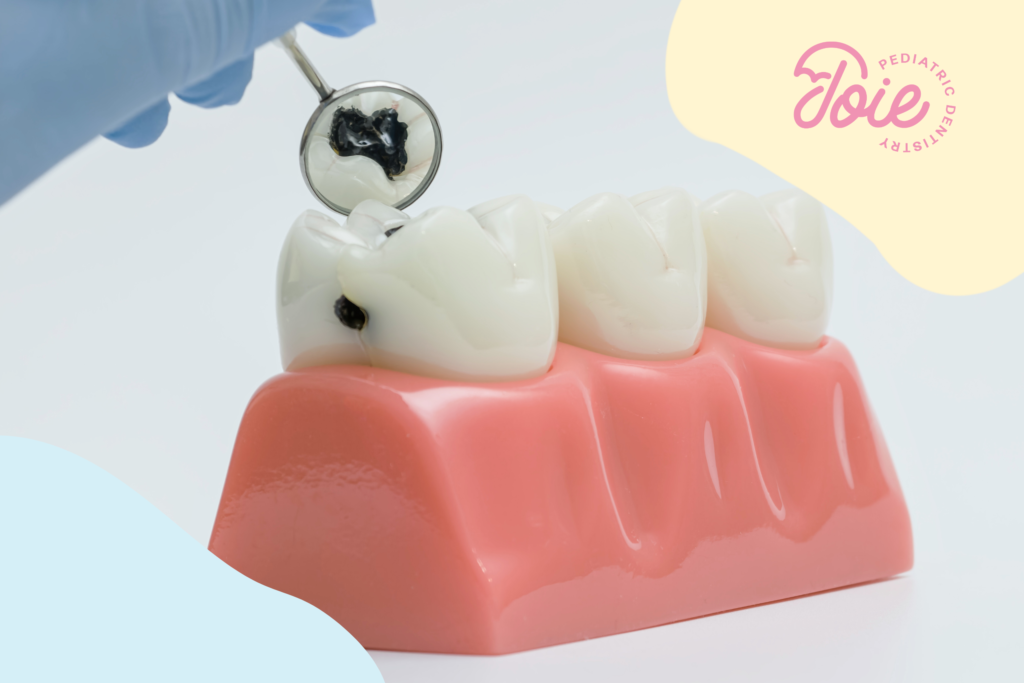
Spotting a Cavity on Your Child’s Teeth, Stage by Stage
A cavity does not start as a hole. It starts as a chalky white patch you can only see on a dry tooth, and by the time there is a visible hole it has been developing for months. Knowing what each stage looks like is the difference between catching decay while fluoride can still stop it and catching it when it needs a filling. Cavity prevention and treatment for kids is built around finding decay at the earliest stage possible, so here is what to look for, where it hides, and which dark spots on a child’s tooth are not cavities at all.
Quick answer: The earliest cavity is a dull, chalky white spot near the gumline, visible only when the tooth is dry. It darkens to brown, then black, then breaks into a soft hole. Only the first stage is reversible. Not every dark spot is active decay: arrested cavities, silver diamine fluoride, and surface staining all look alarming and need no drilling.
What a cavity looks like at each stage
Decay moves through predictable stages, and each one looks different. The first sign is a dull, chalky white area, usually along the gumline of the upper front teeth or on the biting surface of a molar. It is easy to miss because it only shows on a dry tooth; wipe the tooth with gauze and look again under good light. At this point the enamel has lost minerals but has not broken, and fluoride, better brushing, or silver diamine fluoride can still rebuild it. As demineralization continues the spot picks up stain and turns light brown or gray, still smooth, still confined to enamel. When decay reaches the dentin underneath, the spot darkens and the tooth may look shadowed or gray from below even where the surface still looks intact. A tooth at this stage often becomes sensitive to cold and sweet. Next the surface caves in and you can see or feel an actual hole with a soft, rough floor. In the last stage the decay reaches the nerve, and the giveaway is no longer the tooth but the gum: a pimple-like bump, swelling, or a child who wakes at night in pain.
| Stage | What you see | What your child feels | What it needs |
| 1. White spot | Dull, chalky white patch, visible only on a dry tooth | Nothing | Fluoride, brushing changes, or silver diamine fluoride |
| 2. Enamel decay | Spot picks up stain, turns light brown or gray, still smooth | Usually nothing | Filling, or SDF to arrest it |
| 3. Dentin decay | Darker spot, or a gray shadow under intact-looking enamel | Sensitivity to cold and sweet | Filling |
| 4. Cavitation | A visible hole with a soft, rough floor, or a broken edge | Pain when eating, sensitivity | Filling or crown |
| 5. Nerve and abscess | Bump or swelling on the gum near the tooth | Night pain, pain on pressure | Pulp therapy or extraction, promptly |
Only the first stage is reversible, and the window is narrower than most parents expect. We cover what actually reverses an early cavity in a separate piece.
Where cavities hide on a child’s teeth
Most cavities in children do not develop where you would naturally look. The deep grooves on the chewing surface of the molars trap food and are too narrow for a toothbrush bristle to reach, which is why they account for a large share of decay in school-age children. Cavities between the teeth are effectively invisible from the outside and usually show up first on an X-ray. The gumline of the upper front teeth is the classic pattern in toddlers, especially with a bottle or sippy cup at bedtime, because the tongue does not cover those teeth during sleep. Decay also restarts around the edges of older fillings. This is why an exam finds cavities you cannot see at home, and why nothing you do with a flashlight replaces one.
Dark spots that are not cavities
A dark spot is not automatically an active cavity, and this is where parents worry most. An arrested cavity is decay that stopped: it looks black, but it is hard and glassy to the touch, and it needs monitoring rather than a drill. If your child has had silver diamine fluoride, the treated spot turns permanently black by design; that black stain is the cavity being killed, not spreading. Some children develop a dark line or band right at the gumline from chromogenic bacteria or from iron supplements. It looks like decay, wipes back after a cleaning, and is cosmetic. White spots have their own list of causes, including too much fluoride and enamel that never formed fully. The distinction is texture and hardness, which is why a spot gets checked rather than guessed at.
How to check your child’s teeth at home
You can do a useful check at home in under a minute. Sit your child with their head in your lap under a bright light, lift the upper lip fully so you can see the gumline of the front teeth, and dry each tooth with a piece of gauze before you look. Drying matters: the standard clinical scale for scoring early decay separates a lesion visible only after air drying from one visible on a wet tooth, because that difference marks how far the enamel has broken down. Check the biting surfaces of the back molars for dark grooves, and look at the gum itself for any bump or swelling. If floss catches, tears, or shreds in the same spot every time, that is worth mentioning even though you will not see anything. Do not probe with anything sharp, since pressure on softened enamel can break through a surface that could have been remineralized.
What each stage needs
Treatment follows the stage. A white spot usually needs fluoride varnish, better home brushing, and a recheck, or silver diamine fluoride to arrest it without drilling. Decay through the enamel and into the dentin needs a filling, and restorative care for kids covers what that involves. Deeper decay that reaches the nerve needs pulp therapy, often with a crown over it. Swelling, a gum bump, or night pain is a dental emergency rather than something to watch. On a baby tooth, how soon a cavity needs treating also depends on how close the tooth is to falling out, which is a separate decision we walk through with parents.
Frequently Asked Questions
Can a cavity be white?
Yes, and a white cavity is the best kind to find. A dull, chalky white spot is the first stage of decay, before the enamel breaks. It is also the only stage that can still be reversed with fluoride or arrested with silver diamine fluoride instead of a filling.
Does a cavity always hurt?
No. Most cavities cause no pain until decay reaches the dentin, and some cause none until the nerve is involved. A child with no complaints can still have several cavities, which is the main reason exams are scheduled rather than triggered by symptoms.
Why is my child’s cavity black but hard?
That is usually an arrested cavity, decay that stopped progressing when diet or brushing changed. It is hard and glassy rather than soft, and it often needs monitoring rather than treatment. A tooth treated with silver diamine fluoride also turns black permanently, by design.
Can you see a cavity between the teeth?
Rarely. Cavities between teeth stay hidden behind the contact point and usually appear first on an X-ray, sometimes years before anything is visible. Floss that consistently shreds in one spot is the closest thing to a home clue.
When should a spot on my child’s tooth be checked?
Any spot that is new, that has darkened, or that you can feel a texture change in is worth a look. So is any gum bump or swelling, which needs attention promptly. If your child has not had a first visit yet, a spot you are unsure about is a good reason to book one.
We check every tooth surface, and take X-rays when they are due, at each routine visit, which is how cavities get found before they need more than fluoride. If you have spotted something you are unsure about, call us at (201) 500-6314 or book online.
Let’s Make Your First Visit Easy
Whether you’re from Ramsey, Mahwah, Allendale, or anywhere in Bergen County, we’d love to welcome your family to ours.
SHOWTIMES (HOURS)
Monday: 9:00 AM – 5:00 PM
Tuesday: 9:00 AM – 5:00 PM
Wednesday: 9:00 AM – 5:00 PM
Thursday: 9:00 AM – 5:00 PM
Friday: 9:00 AM – 5:00 PM
Sat/Sun: Closed