Why Brushing Is Hard for Your Autistic Child, and What Helps
If your autistic child pushes the toothbrush away, it usually means brushing is too much for them, not that they’re being difficult. Brushing teeth with an autistic child puts a lot on their senses at once: a strong taste, a mouth full of foam, bristles on the gums, sometimes a buzzing motor, all in a small, bright bathroom. Autistic kids with more sensory sensitivities have a harder time with brushing at home, so the most useful first step is to work out which part bothers your child most and change that one thing. If home brushing still isn’t working after that, our special needs pediatric dentistry team can help.
Quick answer: Find the part of brushing that bothers your child most (the taste, the foam, the feel of the brush, the noise or a change in routine) and change that first. Use a flavor-free or low-foam fluoride toothpaste, a small soft brush, and a regular brush before an electric one, and brush at the same time and place every day. Use a rice-grain smear of toothpaste under age 3 and a pea-size amount from 3 to 6. If brushing is still impossible after a few weeks, see a pediatric dentist who works with autistic kids.
When the taste or foam of toothpaste is too much
Most kids’ toothpastes are strongly flavored with fruit, bubblegum or mint, and they foam a lot. For a child who is sensitive to taste or texture, that mouthful of foam can end brushing in seconds, which is why the toothpaste is usually the first thing to change.
A flavor-free fluoride toothpaste removes the taste problem, and one labeled SLS-free makes much less foam, since SLS is the ingredient that makes toothpaste lather. Using less paste helps too: a rice-grain smear under age 3 and a pea-size dab from 3 to 6. Flavors and ingredients in kids’ toothpaste vary a lot between brands, so expect a few tries before one sticks. Once your child accepts one, buy several tubes, because if the brand changes its formula you may have to start over.
When your child won’t let the brush in their mouth
Some kids don’t mind the taste at all. What they can’t stand is something in their mouth, so they close their lips, turn their head or push the brush away. The answer is to go slowly. Let your child hold and play with the brush outside the bathroom first, then touch it to their hand, their cheek and finally their lips, moving on only when the last step goes calmly. Counting out loud and stopping at a set number tells your child exactly when brushing will end. Start at five and add a few seconds each week.
A small head with extra-soft bristles is gentler on the gums, and brushes with bristles on three sides clean the front, back and top of the teeth in one go, so brushing is over sooner. If bristles are still too much, start with a soft silicone finger brush or a damp washcloth. If your child gags easily, keep the brush away from the back of the tongue and angle it toward the cheek side of the back teeth.
The buzz and noise of an electric brush
Electric toothbrushes clean well, but your child feels the noise and vibration through the teeth and jaw. Some kids who are fine with a regular brush can’t handle an electric one, while others love the steady buzz and brush longer with it.
If you want to try one, start with it switched off and use it like a regular brush for a week or two. Then let your child turn it on in their hand, away from the mouth, and bring it to the teeth only once that feels normal, on a gentle or sensitive setting if the model has one. No electric brush is silent, and some are louder than others. If it still isn’t working after a few weeks, a soft regular brush used every day is enough. The trade-offs between electric and manual toothbrushes for kids are worth a look before you buy.
When any change in the routine ends brushing
Many autistic kids can only manage brushing when it happens exactly the same way every time. A new brush color, a different bathroom or brushing before the bath instead of after can be enough to stop it, so keep everything the same: same time, same room, same steps in the same order, same way of finishing. These help your child follow along:
- A picture schedule with one picture per step (toothpaste on, top teeth, bottom teeth, rinse, done), so your child sees what comes next and when it’s over.
- A “first, then” card: first brushing, then a favorite activity.
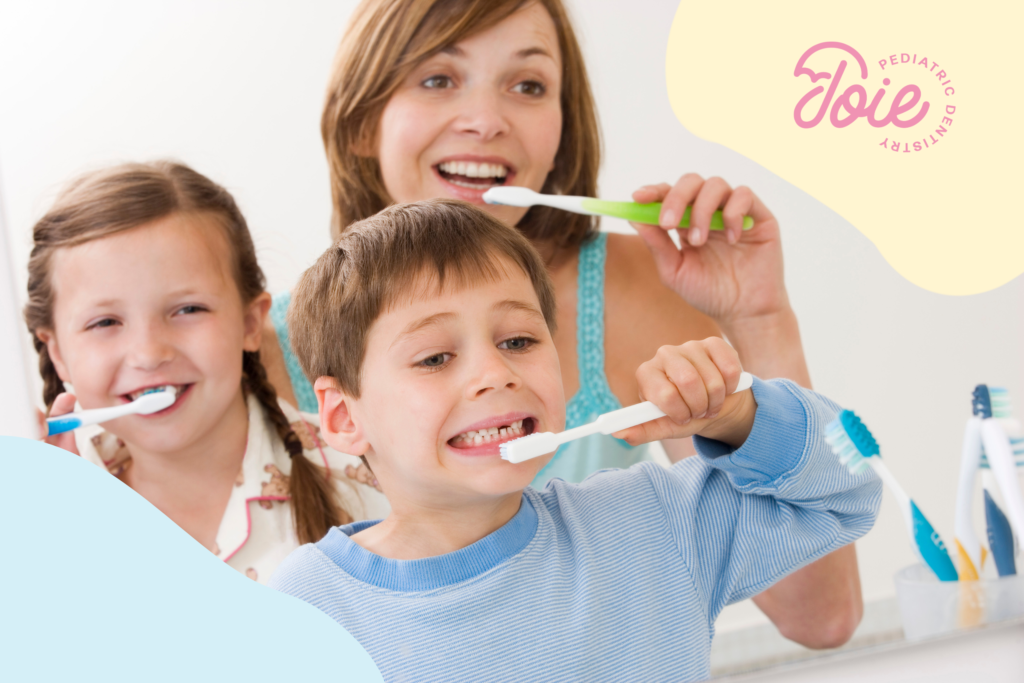
- Brushing your own teeth next to your child, slowly and one step at a time, so they can copy you.
- Praise right away, after each step or at the end, whichever works for your child.
When something has to change, like replacing the toothbrush every three to four months, change only one thing at a time.
Where your child sits and who holds the brush
Where your child sits changes how much you can see and how secure they feel. With younger kids, sit on the floor or the couch with your child lying back and their head in your lap, so you can see every tooth and their head is supported. If your child doesn’t like being face to face, stand or sit behind them with their head resting against your chest. You also don’t have to brush in the bathroom: a couch in a quiet, dim room often works better than a bright bathroom with echoes.
Plan on brushing your child’s teeth yourself, or at least going over them a second time, until around age 7 or 8, and longer if holding the brush steady or staying focused for two minutes is hard. To let an older child take part, put your hand over theirs on the brush: they brush, you guide where and how hard.
When brushing at home stays impossible
On a hard night, a few seconds with a wet brush on the front teeth is better than skipping and keeps the habit going. If your child can’t brush most days for several weeks, or you notice bleeding gums, chalky white spots near the gums, brown spots on the teeth or bad breath that doesn’t go away, it’s time to see a dentist. Fluoride varnish at checkups adds protection while you build the routine at home.
At Joie, our special needs visits start before anyone looks at a tooth:
- Get-to-know-us visits with no treatment at all: your child sees the room, sits in the chair, meets the team and goes home.
- Quieter appointment times, booked when the office is calm.
- Pictures and step-by-step materials sent before the visit, so your child knows what the office looks like and what will happen.
- General anesthesia in a hospital for children who can’t handle treatment in the dental chair, one of the sedation options for children we talk through with parents.
The rest of the visit follows the same ideas behind sensory-friendly dentistry, and a first visit is a good time to go over your child’s brushing routine together. If brushing still isn’t happening most nights, our special needs dental care team can help you plan the next step.
Frequently Asked Questions
How often should an autistic child brush their teeth?
Twice a day for two minutes, the same as any child. While you’re building the habit, one calm brushing at night matters more than two rushed ones, because your child makes less saliva during sleep and teeth are less protected overnight.
Is it okay to brush without toothpaste?
Yes, as a starting point. A wet brush still cleans off plaque and keeps the habit going. Fluoride is what protects the teeth, so add a small amount of toothpaste back as soon as your child can handle it.
At what age can an autistic child brush on their own?
It depends more on hand control and focus than on age. Most kids need a parent to brush or check until around 7 or 8, and many autistic kids need help for longer.
Let’s Make Your First Visit Easy
Whether you’re from Ramsey, Mahwah, Allendale, or anywhere in Bergen County, we’d love to welcome your family to ours.
SHOWTIMES (HOURS)
Monday: 9:00 AM – 5:00 PM
Tuesday: 9:00 AM – 5:00 PM
Wednesday: 9:00 AM – 5:00 PM
Thursday: 9:00 AM – 5:00 PM
Friday: 9:00 AM – 5:00 PM
Saturday: By appointment only
Sun: Closed
References
Khrautieo T, Srimaneekarn N, Rirattanapong P, Smutkeeree A. Association of sensory sensitivities and toothbrushing cooperation in autism spectrum disorder. International Journal of Paediatric Dentistry. 2020;30(4):505-513. doi:10.1111/ipd.12623. PubMed: https://pubmed.ncbi.nlm.nih.gov/32011037/ (the one external link in the body).
Floríndez LI, Como DH, Law E, Tran CF, Johnson R, Polido JC, Cermak SA, Stein Duker LI. Oral care interventions for autistic individuals: a systematic review. Autism. 2025;29(1):41-52. doi:10.1177/13623613241260171. Supports the statement on visual preparation at home; cited in text without a link.