Your Child Hit Their Mouth: What to Check in the First Ten Minutes
Most mouth injuries in young children happen between one and three, when walking is new and the upper front teeth take the impact. Mouths bleed heavily from small cuts, so the first look is usually worse than the injury. The sequence below is what to check and in what order, which injuries can wait until the morning, and which need an emergency pediatric dentist right away
Check the child before checking the teeth
A fall hard enough to injure the mouth can injure the head. Before looking at the teeth, check for loss of consciousness even briefly, vomiting, unusual drowsiness, confusion, or a child who seems not themselves. Any of those means an emergency room first and the teeth later. A nosebleed that will not stop, difficulty breathing, or a jaw that will not close normally are also emergency room signs. If none of those apply, the injury is to the mouth, and the rest of this page is for that.
Stop the bleeding before you look for damage
Fold a piece of gauze or a clean cloth, press it firmly against the bleeding area, and hold for ten minutes without lifting to check. Lifting resets the clock. A child old enough to follow instructions can bite down on it. Keep the head upright and tilted slightly forward so blood is not swallowed. Cold on the outside of the lip or cheek, an ice pack in a cloth, slows both bleeding and swelling. Most cuts inside the mouth stop within ten minutes. One that is still bleeding freely after fifteen minutes of firm pressure, or a cut that gapes open when you look at it, needs stitches and goes to an emergency room or urgent care.
Lift the lip and check four things
Lift the upper lip fully, since the top front teeth are injured far more often than any others, and look at each of the four things below with a phone flashlight. Take a photo before you touch anything; it helps the dentist and it records the position of the teeth before they move.
| Look at | What you might find | What it means | What to do |
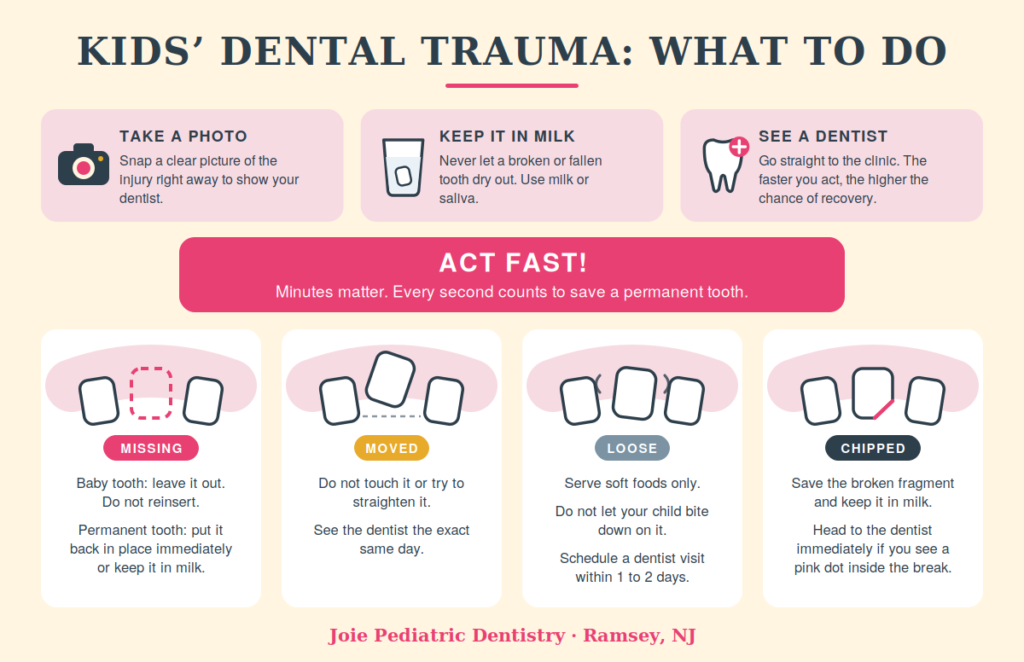
| Is every tooth there? | A tooth is missing from the row | The tooth was knocked out | Baby tooth: do not put it back. Permanent tooth: put it back now. See the knocked-out tooth protocol linked below |
| Is every tooth where it was? | A tooth pushed up into the gum, pushed forward or back, or sitting lower than its neighbor | The tooth has moved in the socket | Do not push it back yourself. Dentist the same day, before a clot forms and makes repositioning harder |
| Does any tooth move? | A tooth wobbles when touched lightly but is in the right place | The ligament holding it has been stretched | Soft food, no biting on it, dentist within a day or two |
| Is any tooth broken? | A corner or edge missing, or a crack | A chip or fracture | Keep any fragment in milk. Dentist within a day; sooner if a pink or red spot shows in the broken area |
A pink or red spot in the middle of a broken tooth means the fracture has reached the nerve, and that changes the timeline from days to hours. Cuts on the inside of the lip, the tongue, and the gum are usually visible at this stage too; those that have stopped bleeding and do not gape closed on their own.
When a tooth has been knocked out completely
The answer depends entirely on whether it was a baby tooth or a permanent one. A baby tooth is never put back, because doing so can damage the permanent tooth forming directly beneath it. A permanent tooth is put back immediately, within minutes if possible, and held in place; the first-aid sequence for a permanent tooth is the one exception to the general rule that a parent should not put anything back into a child’s mouth. Baby teeth have smooth, rounded edges and are small; permanent front teeth are larger with slightly ridged edges and arrive from around age six. If you are not sure, treat it as permanent and put it back, since a dentist can remove it later if needed, while a permanent tooth left out for an hour usually cannot be saved.
When a tooth has been pushed in, tilted, or moved
A tooth that has been pushed up into the gum, tilted forward or back, or partly out of the socket should be left where it is. Repositioning is not a home procedure, and a tooth pushed into the gum in a toddler often re-erupts on its own over the following weeks without intervention. What it does need is a dentist the same day, because the assessment is time-sensitive: once a blood clot forms in the socket, moving the tooth back becomes harder and the options narrow. Offer soft food, nothing that needs biting with the front teeth, and cold on the outside for swelling.
When a tooth is chipped or cracked
Find the fragment if you can, since a clean break can sometimes be bonded back. Keep it in milk, not water and not dry. Rinse the mouth gently with water and check the broken surface: white or yellowish means the break is in enamel or dentin and can usually wait until the next day; a pink or red spot means the nerve is exposed and needs attention within hours to protect it.
When nothing looks wrong but it hurts to bite
A tooth that took a blow can look and sit normally and still be injured. The sign is pain on biting or on light tapping, sometimes with the tooth feeling slightly high or different. This is a dental concussion, a bruise to the ligament around the root, and it usually settles over a week or two with soft food. It still needs a dentist visit within a few days, because a concussed tooth can lose its blood supply silently and the first sign is a color change weeks later. A tooth that turns grey, dark, or pink after an injury, whether at two weeks or two months, needs to be seen.
What to bring to the dentist, and what to watch afterward
Bring the photo, any fragment or tooth in milk, and a note of when it happened and how, since the mechanism of the injury tells the dentist what to look for. Over the following weeks, watch for four things: a tooth changing color, a pimple-like bump on the gum above the tooth, pain that returns after settling, and any swelling. Any one of them means the tooth needs to be re-checked. A bump on the gum after an injury means the nerve has died and infection has followed, and it is treated the same way whether the cause was a cavity or a fall.
Frequently Asked Questions
Should I take my child to the ER or the dentist after a mouth injury?
The emergency room for anything involving the head: loss of consciousness, vomiting, confusion, or drowsiness. Also for bleeding that will not stop after fifteen minutes of firm pressure, a cut that gapes open, or a jaw that will not close. Everything else, including a knocked-out, moved, loose, or broken tooth, is a dental injury and a dentist is the right place.
How long should I press on a cut in the mouth to stop bleeding?
Ten minutes of firm, uninterrupted pressure with folded gauze or a clean cloth. Do not lift it to check partway through. If it is still bleeding freely after fifteen minutes, it needs to be seen.
Can a toddler’s tooth that was pushed up into the gum come back down?
Often, yes. A baby tooth pushed into the gum frequently re-erupts on its own over several weeks, which is why the usual approach is to monitor rather than intervene. It still needs a same-day assessment to rule out damage to the permanent tooth beneath it.
A tooth looks fine but my child says it hurts to bite. Is that an emergency?
Not an emergency, but not something to skip. Pain on biting after a blow with no visible damage is usually a bruised ligament around the root. It needs a dentist within a few days and soft food until then, because the tooth can lose its blood supply without any outward sign until it changes color weeks later.
If your child has hit their mouth, call us at (201) 500-6314 and describe what you see, and send the photo if you have one. If your child has never been to a dentist, an injury is not the ideal first visit, but it is a reason to get one on the calendar once things have settled.
Let’s Make Your First Visit Easy
Whether you’re from Ramsey, Mahwah, Allendale, or anywhere in Bergen County, we’d love to welcome your family to ours.
SHOWTIMES (HOURS)
Monday: 9:00 AM – 5:00 PM
Tuesday: 9:00 AM – 5:00 PM
Wednesday: 9:00 AM – 5:00 PM
Thursday: 9:00 AM – 5:00 PM
Friday: 9:00 AM – 5:00 PM
Saturday: By appointment only
Sun: Closed