When Can Kids Brush Their Own Teeth? When to Stop Helping
Most kids can start brushing their own teeth around age six, but starting the job and finishing it well are two different things. The hands that can hold a toothbrush at three can’t reliably clean every surface until much later, which is why pediatric dentists treat brushing as a supervised task long after a child insists they’ve got it. Here’s how to tell when your child is genuinely ready, when to stop doing it for them, and when you can finally stop checking.
Quick answer: Children can usually begin brushing on their own around age 6, often signaled by being able to tie their own shoes or write their name. Keep supervising and re-checking until around age 10, when most kids have the dexterity to clean every surface reliably. Readiness is about skill, not a birthday, so let ability set the pace.
Why young hands can’t brush well, even when they try
Brushing thoroughly takes more fine motor control than it looks. A toddler or preschooler can move a brush around their mouth, but reaching the back molars, angling the bristles along the gumline, and cleaning the inner surfaces of the teeth all take coordination that develops slowly. The result is that a three or four year old brushing solo tends to scrub the front teeth they can see and miss everything else. This isn’t a discipline problem; the hands simply aren’t ready. The same goes for duration: even a willing child rarely brushes for the full two minutes a thorough clean needs, drifting off after fifteen or twenty seconds. Cavities in young children often form on exactly the surfaces their own brushing skips, which is why an adult does the real cleaning in the early years even when the child wants to do it themselves.
The shoe-tying test for readiness
There’s no birthday that flips a switch, so dentists rely on a practical signal: can your child tie their own shoelaces, or write their name clearly? Both take the same kind of fine motor control and two-handed coordination that thorough brushing needs, so they work as a reasonable stand-in for ready to brush alone. Most children reach this point around six, though some get there at five and others not until seven, and either is normal. Until they can pass that informal test, plan to keep brushing for them or finishing after them. The shoe-tying rule is useful precisely because it’s concrete: it gives you and your child a clear marker instead of an argument about whether they’re old enough.
The two stages: brushing solo and brushing well
It helps to separate two milestones that arrive years apart. Around age six, a child can start brushing on their own, meaning they hold the brush and run it over their teeth without you guiding their hand. That isn’t the same as brushing well. Cleaning every surface reliably, twice a day, for a full two minutes is a skill most children don’t master until closer to ten, which is the age many kids can finally be trusted to brush thoroughly without help. That leaves a multi-year stretch where your child brushes themselves but still needs you to check and catch what they miss. Letting them brush solo at six doesn’t mean stepping away at six.
How to hand it over without losing ground
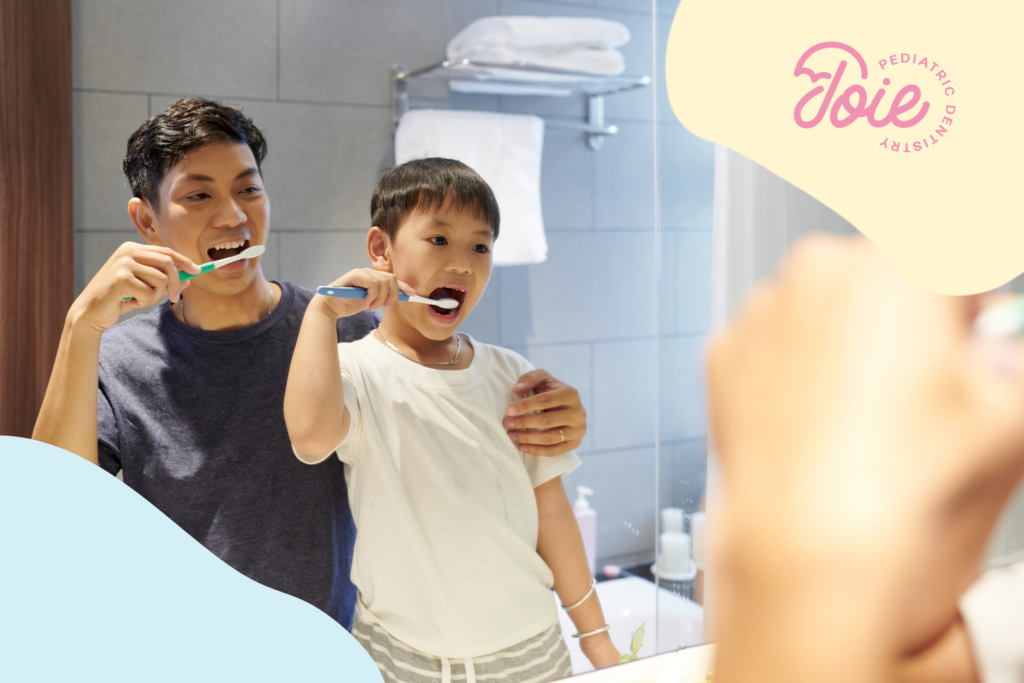
The handover works best as a gradual shift rather than a clean break. A useful method: let your child brush first while you time the full two minutes, then go back in yourself and re-brush the spots they missed, usually the inner surfaces and the back molars. Over weeks, you’ll re-brush less and less. You can also run a quick check by having them brush, then looking for leftover plaque along the gumline and between the back teeth; if it’s still there, they aren’t ready to fly solo yet. Keep dispensing the toothpaste yourself in these years so the amount stays right. The goal is to give your child ownership a piece at a time while making sure nothing important gets skipped during the transition. Our full guide to brushing kids’ teeth walks through the technique itself, step by step.
Why supervision outlasts the toothbrush
Even after your child brushes well on their own, a few things keep you involved a while longer. Spitting toothpaste out instead of swallowing it is a skill of its own, and supervising it matters because swallowing fluoride toothpaste regularly can leave faint white marks on developing teeth. Flossing is harder than brushing and the handover comes later still, often not until eight to ten, so you’ll likely be flossing or checking floss after your child is brushing independently. Sticking with the right toothpaste amount, a rice-grain smear under three and a pea-size dab from three to six, is part of that same oversight. None of this needs to be a fight; framed as a shared routine, it usually isn’t. All of it works alongside the technique we reinforce at routine visits, so our cavity prevention care and the first visit are good moments to have someone watch your child brush and tell you honestly whether they’re ready to take it over.
Let’s Make Your First Visit Easy
Whether you’re from Ramsey, Mahwah, Allendale, or anywhere in Bergen County, we’d love to welcome your family to ours.
SHOWTIMES (HOURS)
Monday: 9:00 AM – 5:00 PM
Tuesday: 9:00 AM – 5:00 PM
Wednesday: 9:00 AM – 5:00 PM
Thursday: 9:00 AM – 5:00 PM
Friday: 9:00 AM – 5:00 PM
Saturday: By appointment only
Sun: Closed