What Pacifier Teeth Really Look Like, and How to Fix Them
Pacifier teeth is the term for a bite changed by long-term sucking on a pacifier: front teeth that do not meet, a narrower upper jaw, or teeth pushed forward. It is not automatic. Whether it happens depends on how long, how often, and how hard your child sucks, more than on whether they use one at all. We check bite development at every kids dental cleaning and exam, so here is what pacifier teeth actually look like, why it happens, when it starts to matter, and what to do about it.
Quick answer: Pacifier teeth means an open bite, flared front teeth, or a narrowed upper jaw from prolonged pacifier use. Most bite changes correct on their own if the habit ends by age 3, though a narrowed palate is slower to self-correct than an open bite. The main levers are duration, frequency, and how hard your child sucks.
Choosing the best pacifier for your baby
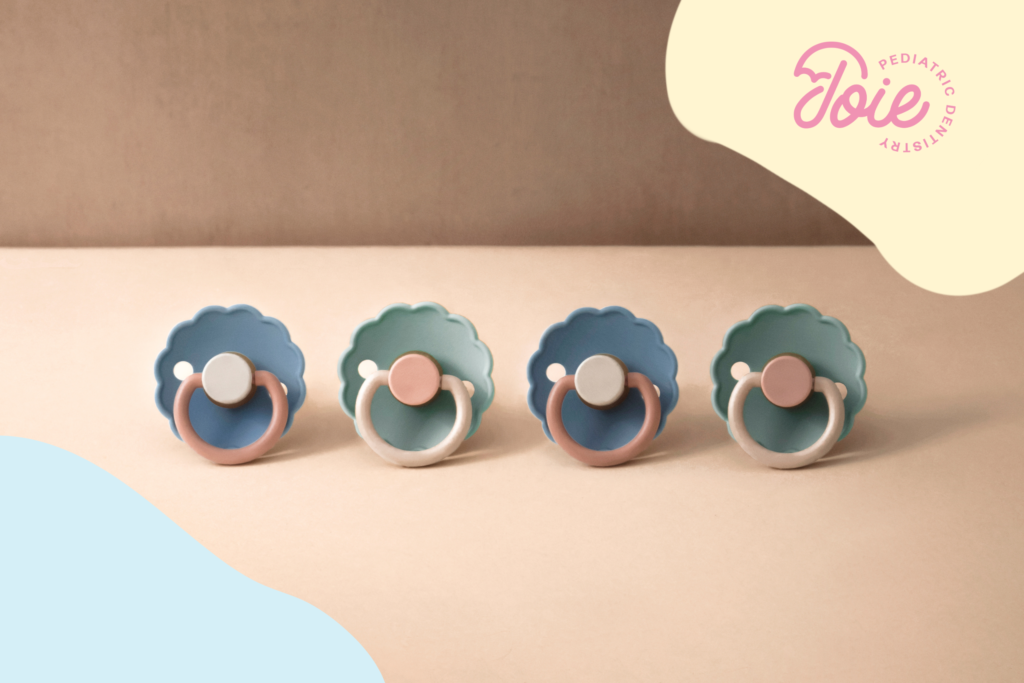
Binky, paci, dummy, soother, whatever you call it, the object itself matters less than how it is used. A one-piece silicone pacifier, sized for your baby’s age, with a firm, ventilated shield, covers what matters most for safety. Shape, an orthodontic flattened nipple versus a round one, is mostly personal preference; neither has been shown to meaningfully change the bite outcomes below on its own. Our full guide to choosing a pacifier covers sizing, material, and safety in more depth.
How sucking pressure moves the teeth
A pacifier in the mouth for hours a day, for months or years, keeps steady pressure on the front teeth and the roof of the mouth while both are still soft and forming. The tongue also sits lower during sucking instead of resting against the palate, which is part of what narrows the upper arch over time. So-called orthodontic pacifiers, the flattened or asymmetric shapes marketed as gentler on the bite, have not been shown in research to meaningfully change that outcome; shape matters far less than the marketing suggests. A 2025 scoping review of thirty-five studies on pacifier use found duration, frequency, and sucking intensity, not simply whether a child uses one, were what predicted the degree of bite change. A pacifier used occasionally during naps affects the mouth very differently than one that stays in all day.
At what age a pacifier starts to affect the teeth
Some professional groups note that measurable changes can start as early as 18 months in children with an intense sucking habit, but that is the earliest edge of a wide range, not a typical timeline. For most children, the risk becomes real around age 2 to 3, and that same review found prolonged use past age 3 significantly raised the chance of changes needing more than time to fix. That is why we, like most pediatric dentists, point to age 3 as the useful deadline rather than the exact day the habit starts to matter. Our guide on stopping the pacifier covers how to end the habit itself.
How an affected bite compares to a normal one
| Sign | With a pacifier habit | A typical bite |
| Front teeth when biting down (open bite) | May not touch, leaving a visible gap | Touch or slightly overlap |
| Upper front teeth angle (flared / protruding) | Can flare forward | Sit close to vertical |
| Back teeth, upper vs lower (posterior crossbite) | Upper molars may sit inside the lower ones | Upper molars sit outside the lower ones |
| Roof of the mouth | Can be narrower and higher | Broad and evenly rounded |
| Tongue position at rest | Low, behind the bottom teeth | Resting against the roof of the mouth |
Not every child with a pacifier habit ends up on the right side of this table, and the severity varies a great deal even among children who use one for years. The open bite and the flared front teeth tend to be the changes that show up first and correct fastest once the habit ends. A narrowed palate moves more slowly in both directions, which is part of why it is the one most likely to still need help later.
What you can do to fix the bite
Stopping the habit is the first step no matter what the bite looks like, since every month of continued use is a month the teeth cannot start moving back. After that, most cases just need time and a routine cleaning and exam to track the bite as the jaw grows, no separate visit required. If the front teeth still do not meet, or the back teeth still sit the wrong way around, by roughly age 7 or 8, interceptive orthodontics such as a palatal expander, sometimes for a gap between the front teeth left behind, is the usual next step, timed to when a child’s jaw still responds well to gentle pressure. We do not treat a mild, still-changing bite the same way we would treat one that has stopped improving on its own, and we would rather watch a young bite through a couple of visits than refer out too early.
Frequently Asked Questions
Will pacifier teeth correct themselves?
Often, yes, for an open bite or flared front teeth, if the pacifier habit ends by around age 3. A narrowed palate or a posterior crossbite is less likely to fully self-correct and is more often the one that still needs orthodontic help later.
When should pacifier teeth be checked by a dentist?
At any routine cleaning and exam, we will flag a bite change if we see one. It is worth mentioning sooner if your child is past 3 and still using a pacifier regularly, or if the front teeth visibly do not meet when they bite down. If your toddler has not had a first visit yet, it is a natural thing to ask about there.
Do pacifiers help with teething?
A pacifier can offer some comfort during teething through sucking and mild counter-pressure, but it does not numb or speed up an erupting tooth the way a cold washcloth or a firm teething ring does.
Is a pacifier or thumb sucking worse for teeth?
Thumb sucking tends to be harder on the bite, mainly because a thumb is available around the clock and there is no way to set it down, wean it in stages, or throw it away, which makes the habit harder to end and easier to prolong.
Can pacifier teeth still show up in adults?
Rarely, and only when a childhood bite change was never treated. Most pacifier-related changes are caught and corrected, through self-correction or orthodontics, long before permanent teeth are affected.
We track bite development at every routine cleaning and exam, pacifier habit or not. If you are noticing a gap, flared teeth, or you are just unsure whether it is time to stop, call us at (201) 500-6314 or book online.
Let’s Make Your First Visit Easy
Whether you’re from Ramsey, Mahwah, Allendale, or anywhere in Bergen County, we’d love to welcome your family to ours.
SHOWTIMES (HOURS)
Monday: 9:00 AM – 5:00 PM
Tuesday: 9:00 AM – 5:00 PM
Wednesday: 9:00 AM – 5:00 PM
Thursday: 9:00 AM – 5:00 PM
Friday: 9:00 AM – 5:00 PM
Sat/Sun: Closed